Bovingdon Brickworks is a well establish breeding territory for the Whitethroat or Common Whitethroat but in 2013 and 2015 it also attracted a Lesser Whitethroat (a far more difficult bird to find locally). This year, another singing male has arrived at the site, details here.
Gadespring too annually attracts one or two Common Whitethroats but this year, Lesser Whitethroat has also been recorded on site, details here.
Thursday, 19 May 2016

Tuesday, 10 May 2016
Highlights from the first week of May
The sunshine and warmth of the first week of May have finally breathed life into Spring. The Green Hairstreaks have emerged at Roughdown (details and more HERE), Dingy Skippers are now flying at the Brickworks and the first moth trapping of the year took place on site (details and more HERE). Finally, a pair of Grey Wagtails are nesting by the River Bulbourne (more info HERE).
Wednesday, 13 April 2016
First moth trapping of 2016
Ben and Roger set themselves the ambitious task of trapping at 3 Box Moor Trust sites simultaneously on 12/4/2016 (Gadespring, Roughdown and Westbrook Hay). In spite of torrential rain, dodgy electrics and spluttering motors, they had the skill, patience and dogged determination to stick with it. Between them, they trapped and netted some exciting specimens: for the full account, including some superb photographs, head on over to Ben's blog, HERE.
Monday, 11 April 2016
Newt Survey
On 7th-8th April, we carried out a newt survey on a couple of the Trust ponds. Check out the Brickworks blog for the results, here.
Tuesday, 5 April 2016
Sunday, 3 April 2016
Chiffchaffs & Toads
Saturday, 12 March 2016
Spring walk along the Bulbourne & first Newt emerges!
 |
| The fantastic Kingfisher pair have been keeping photographers and wildlife enthusiasts entertained through the winter. Bulbroune Meadow, January 2016 |
Grey, dull and wet: not quite the spring weather I was after on Thursday! However, in spite of the dankness, at every stage along the Bulbourne, there was something interesting to see. Mr Kingfisher made off with a decent prize for his good lady. A pair of Wrens were inspecting a nest hole, preparing to raise this year’s brood. The Grey Wagtail pair were together, foraging along the river bank on Bulbourne Meadow, and a couple of Little Egrets were lazily fishing the shallows. Great Tits and Mistle Thrushes were amongst those in full song. Goldcrests seemed to be on the move too, with single birds at separate locations, edging their way along the bank. Finally, on Blackbirds Moor, there were a good 15+ Redwing, darting between the soft ground and the safety of the trees. There were also flocks still at the Brickworks and at Roughdown Common this week.
A few Snowdrops are still hanging on. Primroses and Daffodils are blooming on Harding’s Moor and it won’t be long before the Grape Hyacinths also open up. The latter seem very early.
Full list of bird species seen 10/3/2016
- Wren
- Dunnock
- Robin
- Blackbird
- Song Thrush
- Mistle Thrush
- Redwing
- Woodpigeon
- Feral Pigeon
- Magpie
- Coot
- Moorhen
- Mallard
- Canada Goose
- Black-headed Gull
- Starling
- House Sparrow
- Jay
- Carrion Crow
- Little Egret
- Grey Heron
- Grey Wagtail
- Kingfisher
- Chaffinch
- Goldfinch
- Goldcrest
- Great Tit
- Blue Tit
- Long-tailed Tit
- Red Kite
Frequently seen but not noted on Thursday:
- Kestrel
- Sparrowhawk
- Greenfinch
- Coal Tit
- Nuthatch
- Green and/or Great Spotted Woodpecker
In other news
David K spotted the first of the year's Newts to emerge at Gadespring (HERE). In the coming weeks, we're hoping to survey a few sites and see which species the Trust land supports.
Monday, 29 February 2016
Friday, 29 January 2016
Lesser Redpoll pair still at the Brickworks
A pair of Lesser Redpolls, presumably the same birds that I observed through last month, is still at the Brickworks. A couple of record shots HERE.
Saturday, 23 January 2016
A crisp winter's day & sunlit Buntings
Last Wednesday was one of those crisp, clear frosty days, bathed in sun light.
I came across a wintering Chiffchaff along the Bulbourne on Fishery Moor and, up in the little reed bed bordering Old Fishery Lane, there could have been as many 12 Reed Buntings. I counted at least 8 and photographed 5 of them. A couple were also ringed.

The Kingfishers (male and female) remain faithful to the Bulbourne and continue to attract admirers.

A group of 4 Crows were skittering on ice on Fishery Moor. They were stopping fairly frequently, though, to break off tiny protruding grass icicles, presumably to eat/drink. It seemed to require a great deal of concentration and effort for very little reward!

Amongst the other birds of note were 5 Grey Herons, spread across the Moors, and 3 Little Egrets (one of which was the colour ringed bird LAON(9);RAYN(D), in the Bulbourne west of Old Fishery Lane, last recorded here on 9/11/2015). The resident Kestrel on Harding’s Moor perched up briefly before taking flight to resume the hunt. A Goldcrest came through with a mixed Tit flock on Station Moor, a Song Thrush sang and it was hard to escape the rattles of numerous Mistle Thrushes (10+) favouring the moors east of Station Road.
I came across a wintering Chiffchaff along the Bulbourne on Fishery Moor and, up in the little reed bed bordering Old Fishery Lane, there could have been as many 12 Reed Buntings. I counted at least 8 and photographed 5 of them. A couple were also ringed.

The Kingfishers (male and female) remain faithful to the Bulbourne and continue to attract admirers.

A group of 4 Crows were skittering on ice on Fishery Moor. They were stopping fairly frequently, though, to break off tiny protruding grass icicles, presumably to eat/drink. It seemed to require a great deal of concentration and effort for very little reward!

Amongst the other birds of note were 5 Grey Herons, spread across the Moors, and 3 Little Egrets (one of which was the colour ringed bird LAON(9);RAYN(D), in the Bulbourne west of Old Fishery Lane, last recorded here on 9/11/2015). The resident Kestrel on Harding’s Moor perched up briefly before taking flight to resume the hunt. A Goldcrest came through with a mixed Tit flock on Station Moor, a Song Thrush sang and it was hard to escape the rattles of numerous Mistle Thrushes (10+) favouring the moors east of Station Road.
Thursday, 31 December 2015
Mixed ground-feeding flock at Roughdown
Throughout the winter, there is often a lovely mix of bird species feeding out in the open on Further Roughdown. One morning in October, I had Chaffinch, Green Woodpecker, Redwing and Mistle Thrush all feeding within one square metre. Today, a colourful flock of Greenfinches had joined the throng. For the full count, click HERE.
Monday, 21 December 2015
Warm enough?!
 |
| Meadow Buttercups flowering on Bulbourne Meadow 18th December 2015 |
I thought it was worth just noting the extraordinary weather we’ve had so far this December. On Saturday, temperatures reached 16°C at Northolt (the nearest observation site to Hemel). My car thermometer read 15°C. Mistle Thrush, Song Thrush and Great Tits have started their Spring songs. Robins and Wrens are singing (but do most of the year). Meadow Buttercups are flowering on Bulbourne Meadow and over at the Brickworks today, I came across leaf burst on Hawthorn (which shouldn’t happen for at least another couple of months!). It’s all rather worrying. If we’re going to get very cold weather this winter, it needs to happen asap before plants and flowers are too far along their springtime processes to recover. We’ll just have to watch and wait, I guess.
This will be my last post before 25th, so, I shall wish you all a very happy Christmas. Take care!

Thursday, 17 December 2015
Lesser Redpolls at the Brickworks
Lesser Redpoll is not an easy species to see around Hemel Hempstead and, up until today, I'd not seen them at Bovingdon Brickworks either. For more on the sighting see HERE.
Sunday, 13 December 2015
Mystery burrows at the Brickworks
David K had come across two curious burrows at the Brickworks a few weeks back. Thanks to the use of night time camera traps, we've solved the mystery, HERE.
Saturday, 5 December 2015
The Small Blue Project
The Small Blue: what is it and what does it need?
The Small Blue (Cupido minimus) is the UK’s smallest resident butterfly. Its survival is entirely dependent upon the presence of Kidney Vetch (Anthyllis vulneraria), a plant which can only flourish in early successional conditions (i.e. short-turf grassland with abundant bare ground). Whilst the larvae need the Kidney Vetch, the adult butterflies need places to perch and to roost. Ideal habitats include chalk & limestone grassland, especially with naturally occurring broken ground; man-made habitats such as quarries, gravel pits, road embankments, disused railways and other brownfield sites as well as coastal grassland and dunes.
UK decline and status in Hertfordshire
Across the UK, it’s estimated we’ve lost 80% of our chalk grassland habitat over the last 60 years. That's 80% of the sites where Kidney Vetch has the potential to flourish. And, according to Butterfly Conservation, we’ve lost nearly 40% of the UK’s Small Blue butterfly population since 1970. At the end of 2014, there were only 3 known colonies of Small Blues in the whole of Hertfordshire. It’s rare and is a high priority UK Biodiversity Action Plan species.
Hemel Hempstead 2015
On the 8th June 2015, David Kirk and I happened to spot a single Small Blue butterfly in Dellfield meadow, Westbrook Hay. We could hardly believe our eyes! It was the first to be recorded on Trust land. Further investigations revealed that the roadside verge of the A41, less than 200 metres away, had been planted with Kidney Vetch (KV). Two days later, I counted up to 12 Small Blue butterflies on KV beside the A41 at the Boxmoor/ Bourne End exit.
Eager to confirm breeding, over the next 9 weeks, I visited the A41 site at least once a week. By the middle of July, larvae were appearing on the KV flower heads and at the very end of July, a second, albeit modest generation emerged of at least 3 butterflies. It was the best possible news. And, the Trust, who'd been keeping a close eye on progress, and had already been considering the feasibility of attracting Small Blues to the land, were keen to do everything in their power to help sustain this rare, local breeding population.
The Box Moor Trust Small Blue Project
The KV along the A41 isn't managed or protected. The Trust’s aim is to attract the butterfly to food plants within managed habitat so that the colony is safeguarded. A handful of suitable sites nearby, on Trust land, were identified for an autumn planting of Kidney Vetch: 2 at Roughdown Common (chalk grassland) and a few at Bovingdon Brickworks (a brownfield site with areas of nutrient poor, bare sandy, clay soil). The Trust worked extremely hard to dovetail this project with county-level conservation objectives and researched thoroughly the various conditions needed to ensure that both Kidney Vetch and Small Blues would be given the best chance to thrive. At the end of November / beginning of December, organised and led by David Kirk (Chairman), more than half a dozen enthusiastic helpers (from trustees, staff and volunteers) rolled up their sleeves and planted some 500 seedling plugs and seeds across the two sites.
David (Chairman), Peter Ablett (Chairman of Estate & Land Committee) and other key trustees, volunteers and staff have busted a gut to get this project off the ground before winter. Let's hope the rabbits and slugs munch elsewhere and we reap the well deserved rewards in the spring!
The Small Blue (Cupido minimus) is the UK’s smallest resident butterfly. Its survival is entirely dependent upon the presence of Kidney Vetch (Anthyllis vulneraria), a plant which can only flourish in early successional conditions (i.e. short-turf grassland with abundant bare ground). Whilst the larvae need the Kidney Vetch, the adult butterflies need places to perch and to roost. Ideal habitats include chalk & limestone grassland, especially with naturally occurring broken ground; man-made habitats such as quarries, gravel pits, road embankments, disused railways and other brownfield sites as well as coastal grassland and dunes.
UK decline and status in Hertfordshire
Across the UK, it’s estimated we’ve lost 80% of our chalk grassland habitat over the last 60 years. That's 80% of the sites where Kidney Vetch has the potential to flourish. And, according to Butterfly Conservation, we’ve lost nearly 40% of the UK’s Small Blue butterfly population since 1970. At the end of 2014, there were only 3 known colonies of Small Blues in the whole of Hertfordshire. It’s rare and is a high priority UK Biodiversity Action Plan species.
 |
| 10/06/2015 Small Blue on Kidney Vetch at the A41 Bourne End exit |
On the 8th June 2015, David Kirk and I happened to spot a single Small Blue butterfly in Dellfield meadow, Westbrook Hay. We could hardly believe our eyes! It was the first to be recorded on Trust land. Further investigations revealed that the roadside verge of the A41, less than 200 metres away, had been planted with Kidney Vetch (KV). Two days later, I counted up to 12 Small Blue butterflies on KV beside the A41 at the Boxmoor/ Bourne End exit.
Eager to confirm breeding, over the next 9 weeks, I visited the A41 site at least once a week. By the middle of July, larvae were appearing on the KV flower heads and at the very end of July, a second, albeit modest generation emerged of at least 3 butterflies. It was the best possible news. And, the Trust, who'd been keeping a close eye on progress, and had already been considering the feasibility of attracting Small Blues to the land, were keen to do everything in their power to help sustain this rare, local breeding population.
 |
| Small Blue: larvae through to adult at the A41 colony |
The Box Moor Trust Small Blue Project
The KV along the A41 isn't managed or protected. The Trust’s aim is to attract the butterfly to food plants within managed habitat so that the colony is safeguarded. A handful of suitable sites nearby, on Trust land, were identified for an autumn planting of Kidney Vetch: 2 at Roughdown Common (chalk grassland) and a few at Bovingdon Brickworks (a brownfield site with areas of nutrient poor, bare sandy, clay soil). The Trust worked extremely hard to dovetail this project with county-level conservation objectives and researched thoroughly the various conditions needed to ensure that both Kidney Vetch and Small Blues would be given the best chance to thrive. At the end of November / beginning of December, organised and led by David Kirk (Chairman), more than half a dozen enthusiastic helpers (from trustees, staff and volunteers) rolled up their sleeves and planted some 500 seedling plugs and seeds across the two sites.
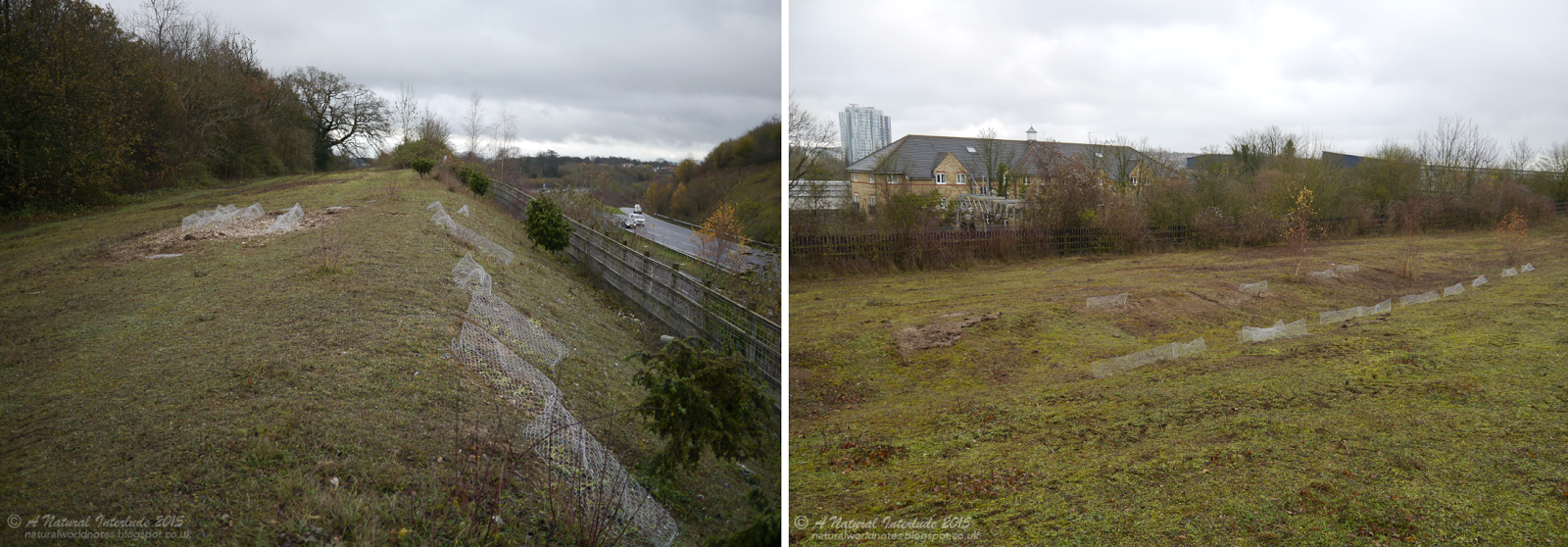 |
| 27/11/2015 Kidney Vetch plants (plugs & seed) protected from rabbits by wire mesh Left: Lower Roughdown south-facing bank by A41. Right: Further Roughdown sheltered gully by railway line |
 |
| 04/12/2015 Kidney Vetch plants (plugs) protected from rabbits by wire mesh South-facing bare-soil banks at Bovingdon Brickworks |
 |
| 04/12/2015 Left: a south-facing bare soil bank was sown with Kidney Vetch seeds. Right: more KV plugs protected by wire mesh Bovingdon Brickworks |
David (Chairman), Peter Ablett (Chairman of Estate & Land Committee) and other key trustees, volunteers and staff have busted a gut to get this project off the ground before winter. Let's hope the rabbits and slugs munch elsewhere and we reap the well deserved rewards in the spring!
Thursday, 26 November 2015
Siskins on Blackbirds Moor
Siskins are resident in the north and west of the UK but, here in Hertfordshire, we have to wait until the winter to spot them. Smart, yellow and black and streaky, these small-billed finches favour the seeds of Alder cones during winter. For the past 3 years, I have been keeping my eyes peeled for them around Trust land but it wasn’t until this autumn that I first saw and heard them on passage migration. The great news is that a small flock are currently feeding in the Alders beside the canal on Blackbirds Moor. They’re best viewed from the canal path with binoculars, from the opposite bank. If you have no luck there, the birds are also occasionally visiting the Alders on Hardings Moor. They'll stay as long as there's food and then they'll be off somewhere new...
Keep your ears open for their whistling calls.
Keep your ears open for their whistling calls.
Sunday, 8 November 2015
Little Egrets hit double figures
The wet weather continued into Saturday and so did the 7 Little Egrets on the Hemel moors. More importantly, 7 became 8 and we hit double figures, TEN(!), for the total number of individuals visiting the Bulbourne in the last couple of months.
Yesterday, 5 birds had gathered on Bulbourne Meadow and 3 were hanging out on Fishery Moor. Amongst them were the same 2 colour-ringed individuals as the previous day. That meant, we’d gained another un-ringed bird, probably attracted to the site by the large gathering. It was also interesting to note that 3 immature Grey Herons were also on Bulbourne Meadow and at least 1 other immature bird, probably 2 more, were further upstream. The most I'd seen on previous visits were 2 immature birds.
So, we’ve had 6 un-ringed and 4 ringed Little Egrets frequent the moors in the last 9 weeks. That’s pretty good going for an area which experiences frequent disturbance from pedestrians, runners, dogs, etc.
 |
| For a brief spell, the rain stopped and the sun came out. 5 Little Egrets on Bulbourne Meadow, 7/11/2015 |
Yesterday, 5 birds had gathered on Bulbourne Meadow and 3 were hanging out on Fishery Moor. Amongst them were the same 2 colour-ringed individuals as the previous day. That meant, we’d gained another un-ringed bird, probably attracted to the site by the large gathering. It was also interesting to note that 3 immature Grey Herons were also on Bulbourne Meadow and at least 1 other immature bird, probably 2 more, were further upstream. The most I'd seen on previous visits were 2 immature birds.
So, we’ve had 6 un-ringed and 4 ringed Little Egrets frequent the moors in the last 9 weeks. That’s pretty good going for an area which experiences frequent disturbance from pedestrians, runners, dogs, etc.
Saturday, 7 November 2015
9 Little Egrets in 9 weeks & Fieldfares arrive
Yesterday, I think the awful weather was to our advantage as it grounded a flock of 5 Little Egrets, 4 of which were new in, on Fishery Moor. The 2 other regular adults were feeding downstream in their favoured areas, making a total of 7 Little Egrets on the moors yesterday afternoon.
The group of 5 included 2 colour-ringed birds, one of which was new in: RBM; LAON(9); RAYN(D), BTO ring GR24046. This individual came from the first ever nest at Verulamium Park in St Albans, ringed on 9th June 2014 by Barry Trevis. It had 3 siblings. In Autumn that year, it was spotted at Startop’s End reservoir, Tring. Finally, it was observed at the end of last year, in December 2014, in the Chaulden area of Hemel. Where it’s been for the last 11 months is anyone’s guess!
In the last 9 weeks, the Box Moor Trust land along the River Bulbourne has been host to at least 9 LITTLE EGRETS: 2 regular un-ringed birds, 3 un-ringed visitors (yesterday) and 4 ringed birds, the latest of which carried the number 9.
Ringed birds:
In other news, I caught up with the Fieldfares at the beginning of last week. On Tuesday, there was a small flock of 11 at Westbrook Hay and another of about 10 in dense scrub at the Brickworks. These birds have likely come from Scandinavia, Finland or northwest Russia and do end up frequently associating with Redwings, as was the case at the Brickworks. Keep your ears peeled for that chack, chack, chack call.
 |
| The group of 5 Little Egrets, including 2 colour-ringed birds, on Fishery Moor, 06/11/2015 |
The group of 5 included 2 colour-ringed birds, one of which was new in: RBM; LAON(9); RAYN(D), BTO ring GR24046. This individual came from the first ever nest at Verulamium Park in St Albans, ringed on 9th June 2014 by Barry Trevis. It had 3 siblings. In Autumn that year, it was spotted at Startop’s End reservoir, Tring. Finally, it was observed at the end of last year, in December 2014, in the Chaulden area of Hemel. Where it’s been for the last 11 months is anyone’s guess!
 |
| Video still, showing the new colour-ringed bird |
In the last 9 weeks, the Box Moor Trust land along the River Bulbourne has been host to at least 9 LITTLE EGRETS: 2 regular un-ringed birds, 3 un-ringed visitors (yesterday) and 4 ringed birds, the latest of which carried the number 9.
Ringed birds:
LAON(9); RAYN(H). BTO ring GR24085, first spotted 03/09/2015 (caught toe)
LAON(H); RAYN(F). BTO ring GR24083, first spotted 04/09/2015
LAON(H); RAYN(C). BTO ring GR24066, first spotted 20/10/2015
LAON(9); RAYN(D). BTO ring GR24046, first spotted 06/11/2015
In other news, I caught up with the Fieldfares at the beginning of last week. On Tuesday, there was a small flock of 11 at Westbrook Hay and another of about 10 in dense scrub at the Brickworks. These birds have likely come from Scandinavia, Finland or northwest Russia and do end up frequently associating with Redwings, as was the case at the Brickworks. Keep your ears peeled for that chack, chack, chack call.
Monday, 26 October 2015
Redwings arrive
Over the last week or so the winter Thrushes have started to arrive locally. Migrant Blackbirds and Redwings have been the most abundant. Over at the Brickworks, I came across a flock of at least 50 Redwing last week. A good few remain on site, and the smaller woodland birds are forming mixed species flocks to give themselves the best chances of survival as winter approaches. For a full species count from this morning, head on over to the Brickworks blog, HERE.
Wednesday, 21 October 2015
Colour-ringed Little Egrets
The River Bulbourne, running through Bulbourne Meadow, is currently a favoured spot for 3 colour-ringed Little Egrets. Two were first spotted at the beginning of September, hatched this spring in St Albans, Verulamium Park. A third bird turned up yesterday, ringed as a juvenile at Lemsford Springs in September 2014. The ring details are as follows:
If you'd like to know more about the history of Little Egrets in Europe and the ringing scheme, I put together a couple of far more rambling posts on my personal blog, HERE and HERE.
LAON(9); RAYN(H). BTO ring GR24085, first spotted 03/09/2015
LAON(H); RAYN(F). BTO ring GR24083, first spotted 04/09/2015
LAON(H); RAYN(C). BTO ring GR24066, first spotted 20/10/2015
 |
| Colour-ringed birds on Bulbourne Meadow, 4 Sept 2015 |
 |
| Third colour-ringed bird, River Bulbourne, 20 Oct 2015 |
If you'd like to know more about the history of Little Egrets in Europe and the ringing scheme, I put together a couple of far more rambling posts on my personal blog, HERE and HERE.
Subscribe to:
Posts (Atom)